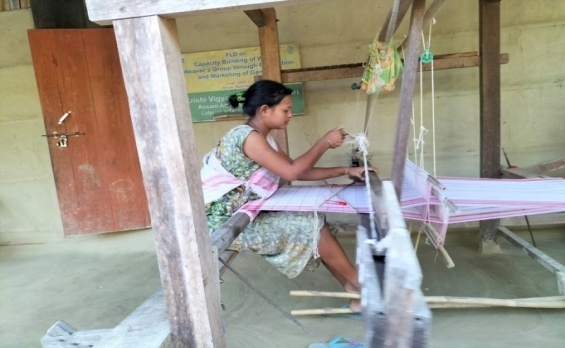
Empowering Rural Women through Handloom Micro-Enterprises
The journey of Rampar Self Help Group, Nalkhamara
Abstract
Handloom weaving is a way of life across rural and urban Assam and an important source of extra income for many households. In Nalkhamara village of Udalguri district, 15 skilled women weavers came together as the Rampar Self Help Group. Limited resources and the lack of a marketing channel held them back, so they sought help from Krishi Vigyan Kendra (KVK), Udalguri. Through a demonstration on capacity building, input support, guidance on modern marketing and help in obtaining the Handloom Mark, KVK helped the group raise its net return by about 166 per cent, from Rs 5.23 lakh in 2019-20 to Rs 13.89 lakh in 2023-24.
Background
The handloom sector plays a vital role in providing employment to rural women in Assam, mainly using natural fibres such as cotton, silk and jute. In the remote areas of Udalguri district, where Bodo and Rabha communities live, women hold rich traditional knowledge and skill in weaving.
Nalkhamara, a village of 214 households, is known for its skilled weavers. Fifteen of its most talented weavers formed the Rampar Self Help Group, but they faced serious difficulties:
KVK Intervention
In 2020-21, KVK Udalguri conducted a demonstration on capacity building of women weavers through production and marketing of handloom products such as gamosa. The aims were to standardise products, improve marketability and raise the weavers’ income. All 15 members took part enthusiastically in the trainings and demonstrations.
Skill Training
Training in weaving, dyeing and design, with emphasis on quality control and standardisation.
Input Support
Supply of different types of natural yarn to the group.
Market Guidance
Guidance on modern marketing, current market trends and customer demand.
Handloom Mark: a seal of quality
KVK helped the group obtain the Handloom Mark label, awarded to products that meet quality and authenticity standards. The label assures buyers of genuine traditional craftsmanship, opened the door to wider markets, and filled the weavers with confidence and pride in their work.
Economic Impact
Before the intervention, in 2019-20, the group earned a gross return of Rs 14.79 lakh against a cost of Rs 9.56 lakh, giving a net return of Rs 5.23 lakh. By 2023-24, the gross return had grown to Rs 35.56 lakh against a cost of Rs 21.67 lakh, and the net return rose to Rs 13.89 lakh, an increase of about 166 per cent. The benefit-cost ratio improved from 1.54 to 1.64. Better product quality, higher productivity, less time and effort per piece and wider market reach all contributed to this growth.
Diversified Products
With KVK’s support, the group has mastered standardised production and now experiments with new designs that keep traditional motifs alive. They make 20 types of products in both Assamese and Rabha designs.
Prices shown are approximate selling price ranges.
Sustainable Practices
The group uses natural fabrics and dyes made from locally available resources. This makes the fabric last longer, protects the environment, and gives the weavers pride in making products that are eco-friendly and socially responsible.
Conclusion
The story of the Rampar Self Help Group shows the resilience, creativity and entrepreneurial spirit of the women weavers of Assam. By preserving traditional craftsmanship while adopting modern techniques and market practices, they have carved out a place for themselves in a competitive market. Their success shows the great potential of the handloom sector for empowering women and developing rural communities. Continued support from government, NGOs and other stakeholders through credit, market linkages and skill development will be vital to keep this heritage alive and help many more women prosper.