Enhancing Farmers’ Income through Integrated Fish-Duck-Horticulture Farming
A three-tier farming model demonstrated by KVK Udalguri in four villages
Abstract
Integrated farming systems that combine several farm enterprises have proved transformative for smallholder farmers. In Udalguri district of Assam, Krishi Vigyan Kendra (KVK), under Assam Agricultural University, introduced a three-tier model integrating fish, duck and horticulture. The system uses the synergy between aquaculture, duck rearing and dyke horticulture to make the best use of resources, recycle farm waste and generate income from several sources. Demonstrated over three years (2017 to 2020) in four villages, the model clearly outperformed traditional fish monoculture in both productivity and profitability. With a net return of Rs 4.40 lakh per hectare and a benefit-cost ratio of 2.69, it has emerged as a sustainable and replicable model for strengthening rural livelihoods and farm resilience.
Introduction
With shrinking landholdings and falling returns from conventional farming, integrated farming systems offer small and marginal farmers a promising alternative. The fish-duck-horticulture system works on the principle of resource recycling and biological synergy.
Horticulture on Dykes
Banana and papaya on pond dykes use nutrient-rich pond silt and organic residues.
Ducks above the Pond
Ducks control insects and aquatic pests, while their droppings and leftover feed fertilise the pond.
Fish in the Pond
Fish benefit from duck manure and feed residue, keeping the pond ecosystem balanced.
Traditional fish farming in Udalguri district had suffered from poor use of inputs, low productivity and uncertain markets. To address these problems, KVK Udalguri, Lalpool (AAU) demonstrated the integrated model on farmers’ fields in four villages to assess its income potential and viability under field conditions:
- Hirabari
- Kacharitol
- Jhargaon
- Deurigaon
KVK Intervention
The model was introduced step by step on selected farmers’ fields over three consecutive years, from 2017 to 2020.
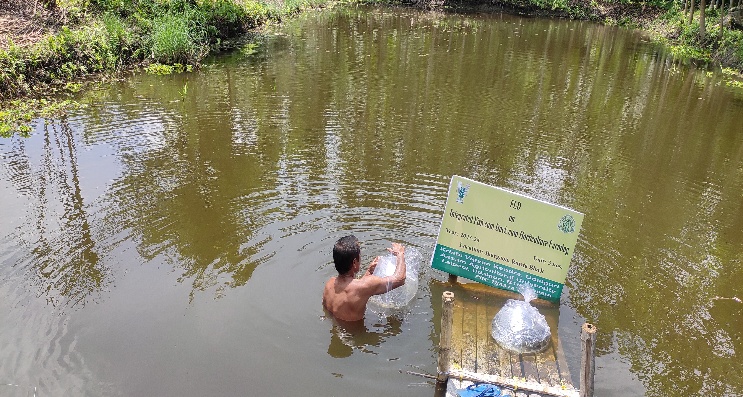
- Fish: stunted yearling fingerlings of catla, rohu, mrigal, grass carp, common carp and silver carp stocked at 6,000 per ha in the ratio 2 : 2.5 : 1.5 : 1.5 : 1 : 1.5
- Ducks: Chara Chambelli ducks housed in bamboo sheds built over the pond, so droppings fall straight into the water
- Horticulture: Malbhog banana and papaya grown on the pond dykes
- Training: pond and duck shed management, feed formulation, water quality monitoring, and integrated pest and nutrient management for dyke crops
Results: Fish
Fish yield in the integrated ponds averaged 38.6 q/ha over three years, about 61 per cent higher than the 23.95 q/ha under traditional practice. Fish also grew much bigger. Catla stocked at 90 g reached 920 g, compared with 530 g in traditional ponds.
Results: Ducks and Horticulture
Ducks in the integrated system weighed 1.80 kg at 72 weeks and laid 165 eggs per bird, against 1.45 kg and 58 eggs under traditional rearing. The pond dykes, which would otherwise lie unused, produced 56 q/ha of papaya and 19 q/ha of banana.
Economic Impact
The integrated system needed a higher investment of Rs 2.59 lakh per ha, compared with Rs 0.84 lakh for traditional fish farming, but it paid back many times over. It gave a gross return of Rs 6.99 lakh and a net return of Rs 4.40 lakh per ha, nearly three times the net return of Rs 1.54 lakh from traditional practice. The benefit-cost ratio rose from 1.83 to 2.69.
Impact on Farmers
The benefits were seen in all four villages. Farmers who earlier depended only on traditional fish farming gained a more secure income from several products, including fish, duck meat, eggs and fruit. Recycling farm waste made better use of every input, and production now continues through the year. Families also eat a more varied and nutritious diet.
Conclusion
The integrated fish-duck-horticulture system has proved to be a sustainable and profitable model for smallholder farmers in Assam. By making each component support the others, it raises productivity, recycles waste, makes the best use of land and water, and builds resilience to climate risks. The experience in Udalguri shows that such integrated approaches can significantly improve rural livelihoods and support the goal of doubling farmers’ income. The model is well suited for replication in similar agro-climatic zones and deserves active promotion through extension, capacity building and convergence with government schemes such as:
- RKVY
- PMMSY
- ATMA