Agri-Entrepreneurship Development through Beekeeping
How Mr. Padamsha Daimary, a rural youth, built a thriving apiary enterprise
Abstract
This is the story of Mr. Padamsha Daimary, a young beekeeper from Udalguri district, BTR, Assam. Awareness programmes, need-based training in scientific beekeeping, regular monitoring of his apiary by Krishi Vigyan Kendra (KVK), Udalguri, and his own determination were the keys to his success. As a traditional beekeeper, he earned only Rs 8,000 to Rs 10,000 a year. Today his beekeeping enterprise brings him up to Rs 5,05,000 a year.
- Keywords:
- Honey bee
- Honey
- Bee colony
- Income
- Rural youth
Introduction
Mr. Padamsha Daimary, a 27-year-old rural youth from a Scheduled Tribe community, lives in Sijonguri village, No. 5 Dhansiri, Udalguri district. Until 2018 he was unemployed. Looking for a way to earn a living, he turned to beekeeping and, towards the end of 2018, started with one colony of local bees reared the traditional way. Each colony gave only 4 to 5 kg of honey a year, barely enough for home use.
He wanted to produce good-quality honey commercially but lacked scientific knowledge. In search of guidance, he visited KVK Udalguri at the end of 2018, hoping to become a commercial beekeeper and build a better life.
- Late 2018Started traditional beekeeping with one colony of local bees
- End of 2018Approached KVK Udalguri for scientific guidance
- 2019Established his apiary on scientific lines; income began to rise sharply
- Today150 colonies, a model apiary and a role as master trainer
KVK Intervention
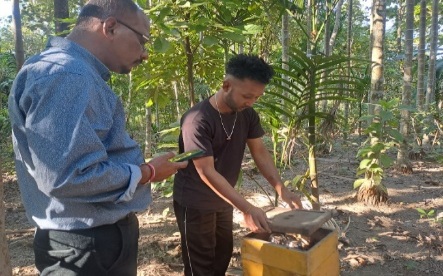
KVK scientists discussed his problems, resources and available land with him. Subject experts then visited his area and drew up a plan covering site selection, placement of bee boxes and colony management. Following this plan, KVK carried out a series of activities to develop his farm into a model unit.
Under this guidance, his apiary has become a model beekeeping enterprise in the area. He now rears two species:
Innovation: Honey in the Bottle
A bee box that fills bottles directly
Mr. Daimary designed a honey box in which empty bottles replace the frames in the honey chamber. The bees build comb and store honey directly in the bottles, so no separate extraction is needed. Customers value this fresh comb honey for its quality.
Achievements
Before (traditional)
- Two colonies of local bees
- 4 to 5 kg honey per colony a year
- Rs 8,000 to Rs 10,000 a year
Now (scientific)
- 150 colonies of two species
- 1.5 to 2 q honey a year
- Up to Rs 5,05,000 a year
His income comes from three sources: honey, sale of bee colonies and sale of bee boxes.
He has reinvested his earnings in the farm and now owns a power tiller, irrigation motor and small farm implements, and shares a tractor with his group.
- Power tiller
- Tractor (in group)
- Irrigation motor
- Small farm implements
Market Linkage
Local customers strongly prefer raw honey, and he supplies the retail markets of Udalguri district and the wider BTR area. His bee colonies are also in demand beyond Assam, and buyers collect them directly from his home.
- Udalguri district
- BTR, Assam
- Meghalaya
- Nagaland
- Tripura
Champion Farmer and Master Trainer
Mr. Daimary is now recognised as a champion farmer in beekeeping in Udalguri district, and many farmers follow his example. As a master trainer, he shares his knowledge so that others can also start apiaries on scientific lines.
Conclusion
Awareness creation, scientific training, regular monitoring and strong willpower together turned Mr. Padamsha Daimary from a traditional beekeeper with two colonies into a successful entrepreneur with 150 colonies. His story shows that scientific beekeeping can greatly raise the income of rural youth and farmers, even those with very little land.