Integrating Crops, Horticulture and Livestock for Higher Farm Income
How Mr. Ramlal Mahato grew from an unemployed youth into a large-scale integrated farmer
Abstract
This is the story of Mr. Ramlal Mahato, a 33-year-old farmer of 1 No. Niz Garuajhar village, Udalguri district, Assam. He moved from traditional crop cultivation to mechanised, improved farming that integrates field crops, horticulture and livestock. This integration, along with his determination, hard work and careful planning, has raised his annual net income from Rs 1,50,000 to Rs 86,41,000. Of this, field crops contribute Rs 12,95,000, horticultural crops Rs 12,46,000 and animal components Rs 61,00,000. His farm also provides employment to more than 40 rural youths.
- Keywords:
- Integration
- Agriculture
- Horticulture
- Farm economics
- Employment
Introduction
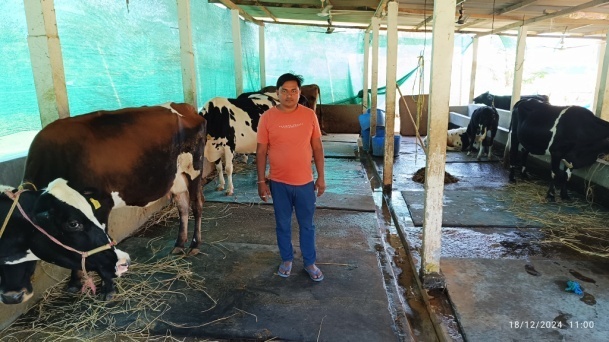
Mr. Ramlal Mahato, who studied up to Class 10, was an unemployed youth in 2014. That year he grew bitter gourd and, thanks to his hard work, got a good harvest, which sparked his interest in farming. Today he farms 20 ha with improved machinery, growing improved field and horticultural crops alongside a dairy unit of HF, Jersey and Sahiwal cows, a BV-380 poultry unit and fodder crops.
- 2014Started farming with bitter gourd; a good harvest built his interest in agriculture
- 2020Connected with KVK Udalguri through district departments; began improved field and horticultural crops
- ExpansionPlanted fodder crops, set up a dairy unit and later added poultry and beekeeping
- TodayA 20 ha integrated farm earning Rs 86.41 lakh net a year
KVK Intervention
Keen to grow in agriculture, Mr. Mahato reached out to various departments in Udalguri district and was introduced to Krishi Vigyan Kendra (KVK), Udalguri in 2020. With complete technical guidance from KVK subject experts, he began cultivating improved crops. At the same time, he planted fodder grasses to support a dairy unit, and later added poultry.
Field Crops
- Toria
- Millet
- Wheat
- Maize
- Sorghum
Horticulture
- Arecanut
- Coconut
- Papaya
- Apple
Animal Components
- Dairy: HF, Jersey and Sahiwal
- Poultry: BV-380
- Apiculture
- Fodder: Hybrid Napier, Setaria, Congo signal
Economic Achievement
Mr. Mahato’s annual net income has risen from Rs 1,50,000 to Rs 86,41,000. The dairy unit of 40 cows is the main earner, giving a net income of Rs 61 lakh from a gross return of Rs 1.89 crore against costs of Rs 1.28 crore. Among field crops, millet on 8 ha earns Rs 6,00,000 and toria on 5.3 ha Rs 4,00,000, with maize and wheat adding Rs 1,50,000 and Rs 1,45,000. In horticulture, 2 ha of arecanut gives Rs 10,90,000, while coconut and papaya add Rs 86,000 and Rs 70,000.
Several newer components are still being established and will add to his income in the coming years:
- Apple: 250 plants
- Poultry: 200 birds
- Apiculture: 40 colonies
- Fodder crops
Innovative Practices
Integrated Land Use
Every part of the farm is put to use, with locally available materials used as mulch.
Solar Power
A solar system reduces the farm’s electricity consumption.
Fertigation with Dung and Urine
Cow dung and urine are mixed into irrigation water, feeding crops organically and saving labour.
Impact on the Community
Mr. Mahato actively shares his experience with neighbouring villagers through awareness activities and by showing them his fields. Inspired by his results, more than 56 farmers now grow toria and maize, and over 34 farm families have followed his guidance to raise their incomes through different farming systems. His farm also employs more than 40 rural youths.
Conclusion
Mr. Ramlal Mahato’s journey from an unemployed youth to one of the most successful farmers in Udalguri district shows the power of integrating crops, horticulture and livestock on one farm. With scientific guidance from KVK Udalguri, determination, hard work and careful planning, farmers can earn far more from their available resources while creating jobs and inspiring others in their community.